

(For: Business, Safari, Community, Industrial Projects & Group Travel)
Introduction
Kenya is not only a premier wildlife destination known for its abundant game, contrasting scenery, and coastal attractions — it is also one of Africa’s most important business, diplomatic, and operational hubs.
Nairobi consistently wins the World Travel Awards (WTA) for Africa’s Leading Business Travel Destination, holding the title for multiple consecutive years, including 2025. The city continues to outperform Accra, Cape Town, and Johannesburg due to its growing role as a regional centre for trade, investment, development finance, and international cooperation.
Kenya hosts the global headquarters of UNEP and UN-Habitat, alongside long-established operations of UNHCR and UNON (United Nations Office in Nairobi). Further operational shifts by UNICEF, UN Women, and UNFPA are anticipated as part of the UN’s long-term efficiency agenda under UN@80. Nairobi’s affordability compared to Geneva or New York strongly supports this transition.
As a result, Kenya attracts a wide spectrum of travelers — business executives, diplomats, consultants, project engineers, NGO teams, families, student groups, and safari guests. Vehicle hire in Kenya therefore serves multiple purposes, and choosing the right vehicle is critical for comfort, safety, compliance, and cost control.
Choosing the Right Vehicle in Kenya
Vehicle hire in Kenya is purpose-driven. Below is a clear comparison by use case, not marketing labels.
🚗 Urban & Business Travel Vehicles
Vehicle Type | Capacity | Best For | Key Advantages |
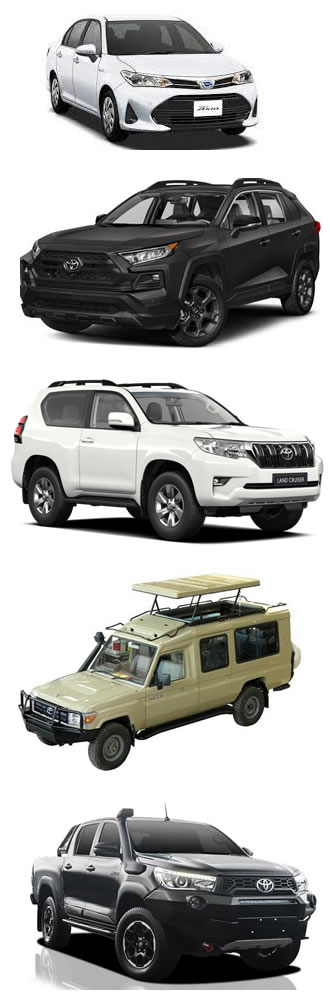
Toyota Axio | 3–4 pax | Business visits, city use, long stays | Fuel efficient, reliable, low running cost |
Toyota Premio / Allion | 3–4 pax | Executive travel | Comfort, stability, prestige |
Why Axio dominates:
The Toyota Axio remains the most requested sedan in Kenya due to its 1.3L–1.5L efficiency, modern safety features, infotainment, and proven reliability for Nairobi and peri-urban commuting.
Available self-drive or with chauffeur.
👨👩👧 Small Groups & Family Travel
Vehicle | Capacity | Best Use |
Toyota Noah / Voxy | 6–7 pax | Families, NGOs, light field work |
Comfortable, flexible seating and luggage space make these ideal for multi-purpose travel.
🚙 SUVs – Comfort, Stability & Prestige
SUV | Ideal For |
Toyota RAV4 / Vanguard | Mixed city & regional travel |
Toyota Prado (incl. V8) | Executive travel, long-distance, rough terrain |
SUVs offer greater road stability, higher ground clearance, and a premium experience.
🚌 Shuttle Buses & Group Transfers
Vehicle | Capacity | Typical Use |
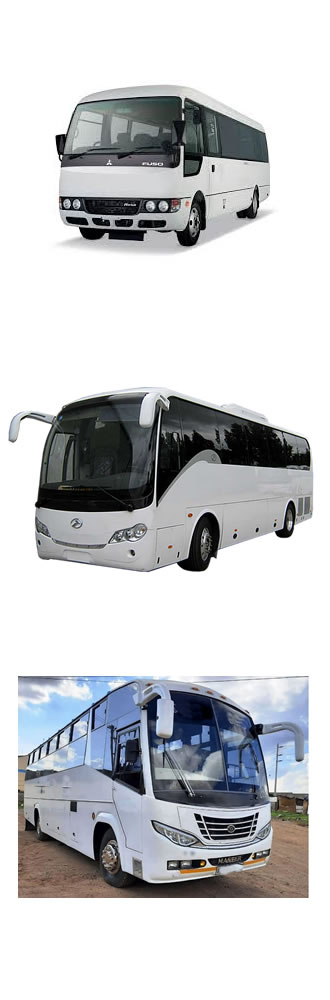
Rosa / Coaster | 22–28 pax | Corporate & airport transfers |
Mercedes Bus | 33 pax | Conferences, NGO transport |
Isuzu Bus | 45 pax | Intercity & institutional use |
Yutong Coach | 50–60 pax | Large group travel |
For groups above 30 passengers, road transfer is often more economical than domestic flights.

🛠 Project & Field Vehicles (Mining, Construction, Infrastructure)
Vehicle | Use Case |
Toyota Hilux / Isuzu D-Max | Field crews, light tools |
Ford Ranger / Navara | Project supervision |
Land Cruiser Pickup | Heavy-duty terrain |
Leasing avoids capital lock-in and aligns with project-based budgeting.
🦓 Safari Vehicles (TRA Licensed – Mandatory)
Vehicle | Terrain | Cost Level |
4×4 Safari Land Cruiser | All parks | Premium |
Safari Minivan | Maintained routes | Affordable |
⚠️ Important:
Safari vehicles must be licensed by the Tourism Regulatory Authority (TRA). Some parks — including Masai Mara — restrict entry by non-licensed or personal vehicles.
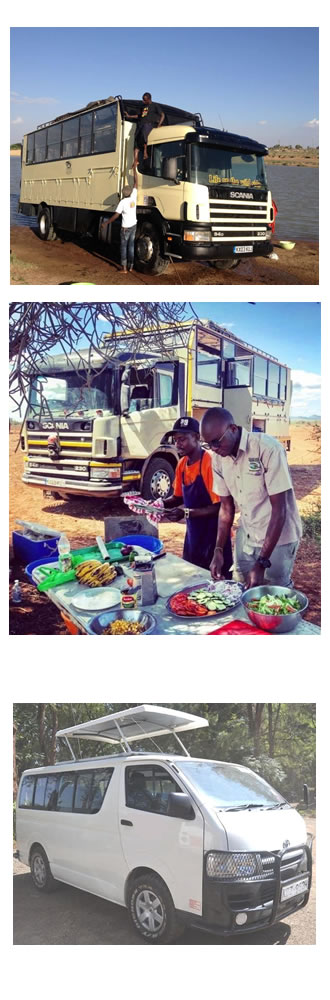
🚐 Overland Vehicles
Capacity | Best For |
16–35 pax | Budget safaris, student groups, medical camps |
Often fly-camping based, with driver and cook included.
- What to Look For – Essentials by Travel Type
Safari Vehicle Essentials
- Pop-up roof
- Cooler box or fridge
- Radio communication
- Charging ports
- Comfortable long-drive seating
- All-terrain tires
Buses & Coaches
- Recliner seats (where applicable)
- Air conditioning
- Vehicle stability and safety systems
- Chauffeur-Driven vs Self-Drive (Critical Distinction)
Chauffeur-Driven / Guided Travel
Most professional operators use guides certified by KPSGA (Bronze, Silver, Gold).
Gold-level guides are extremely rare; even Bronze certification exceeds standard college-level training.
Self-Drive (Higher Responsibility)
Self-drive rentals in Kenya place significant liability on the renter:
- PSV insurance covers the vehicle only
- Occupants and driver injuries are not covered
- Damage to tires, windscreens, interior often excluded
- Insurance excess (deductible) payable by renter
- Security deposits and personal accident cover recommended
Best suited for non-safari travel unless highly experienced.
- Vehicle Hire Price Guide in Kenya (Indicative)
Standard Vehicles
Category | From (USD/day) |
Sedans | 40 (incl. airport transfers) |
7-Seaters | 80 (incl. airport transfers) |
SUVs | 80 |
Toyota Prado | 160 |
Double Cab Pickups | 120 |
Buses
Vehicle | From (USD/day) |
22 Seater | 160 |
33 Seater | 200 |
45 Seater | 250 |
50 Seater | 280 |
Safari & Overland
Vehicle | Rate (USD/day) |
Safari Land Cruiser | 260 (guide, fuel, park fees incl.) |
Safari Minivan | 180 (same inclusions) |
Overland 16 Seater | 400 |
Overland 35 Seater | 600 |
Frequently Asked Questions – Vehicle Hire in Kenya
Q1. What is the best vehicle to hire in Kenya?
A: The best vehicle to hire in Kenya depends on your purpose of travel. Sedans like the Toyota Axio are ideal for business and city travel, SUVs such as the Toyota Prado offer comfort and stability for longer distances, while licensed safari vehicles like the 4×4 Safari Land Cruiser or Safari Minivan are mandatory for game drives in national parks.
Q2. Can I use a normal rental car for a safari in Kenya?
A: Not always. Many national parks, including Masai Mara, require TRA-licensed safari vehicles. Personal or standard rental vehicles may be denied entry. It is important to confirm that the vehicle is approved for safari use before booking.
Q3. Is self-drive car hire allowed in Kenya?
A: Yes, self-drive car hire is available in Kenya, mainly for non-safari travel. However, renters assume greater responsibility, including insurance excess, personal injury liability, and damage not covered under standard PSV insurance. Self-drive safaris are not recommended unless the driver has extensive local experience.
Q4. What is the difference between a Safari Land Cruiser and a Safari Minivan?
A: A Safari Land Cruiser is a 4×4 vehicle designed for rough terrain and all national parks, offering high ground clearance and superior off-road performance. A Safari Minivan is more affordable and suitable for maintained park roads, making it ideal for budget and mid-range safaris.
Q5. Do safari vehicle hire rates include a driver or guide?
A: Most safari vehicle hire rates include the services of a professional driver-guide, fuel disposal per day, and park fees for the driver and vehicle. This should always be confirmed at the time of booking.
Q6. Are chauffeurs available for business and long-term rentals?
A: Yes. Chauffeur-driven vehicle hire is widely available in Kenya and is commonly preferred by business travelers, diplomats, NGOs, and project teams. Chauffeur services provide convenience, local knowledge, and reduced liability for the renter.
Q7. What documents are required to hire a vehicle in Kenya?
A: Typically required documents include a valid driving licence, passport or national ID, and in some cases an international driving permit. For self-drive rentals, a refundable security deposit is usually required.
Q8. Are buses and coaches available for large group travel in Kenya?
A: Yes. Kenya offers a wide range of buses and coaches, including 22-seaters, 33-seaters, 45-seaters, and 50–60 seater luxury coaches. These are commonly used for conferences, institutional travel, intercity transfers, and group safaris.